








Concrete vs Plastic Septic Tanks
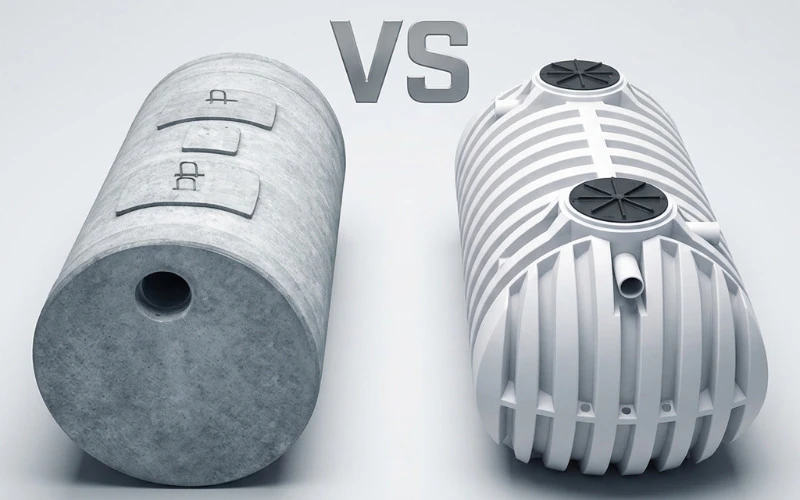
Concrete vs Plastic Septic Tanks
Concrete has been the default septic material for decades, which is why many people use the word to mean any septic tank. Plastic tanks, more precisely polyethylene, are now the other common choice, and the two behave differently enough that the decision is worth a few minutes.
The honest answer is that neither one wins outright. Concrete suits some sites and some counties. Plastic suits others. What decides it is usually your water table, your site access, and what your local authority will permit.
This page lays out where each material has the advantage, so you can work out which one your project actually calls for.
Where each material has the advantage
Concrete is the stronger choice when
- The water table is high, since the weight of the tank resists flotation without additional anchoring
- Your county or state specifies concrete for permitted systems
- A regional plant is close by, which keeps delivery short
- The site can take the equipment needed to set a tank of that weight
Plastic is the stronger choice when
- Site access is tight or the ground will not carry heavy equipment
- You want a lighter tank that can be placed without a crane or boom truck
- Corrosion is a concern, since polyethylene does not react to the gases present in a septic system
- You need a smaller capacity than local concrete suppliers typically stock
Side by side
Requirements vary by jurisdiction, so treat this as a starting point and confirm the specifics with your local health department or a licensed installer.
| Consideration | Concrete | Plastic (polyethylene) |
|---|---|---|
| Weight | Heavy | Light |
| Equipment to set | Crane or boom truck, and ground that will carry it | Lighter equipment, and often smaller crews |
| High water table | Weight resists flotation on its own | Anchoring or ballast is commonly specified |
| Corrosion | Can be affected by gases in a septic environment over time | Does not corrode |
| Backfill | Less sensitive to backfill technique | Bedding and backfill must follow the manufacturer instructions |
| Where it is made | Regional plants, so delivery distances are usually short | Molded centrally and shipped, so freight travels further |
| Local approval | Accepted almost everywhere, required in some jurisdictions | Approval varies by state and county |
| Availability from us | Not carried | Available in our approved states |
What we carry, and what to do if you need concrete
Tank Superstore provides polyethylene septic tanks. We do not carry concrete, and we would rather tell you that here than after you have spent time on the site.
If your county requires concrete, or your water table makes it the better engineering choice, your nearest precast concrete plant is the right call. Concrete is made regionally, so the supplier closest to your site is usually the one to speak to, and a local installer will know who that is.
If plastic works for your project, you can browse our septic tanks or check the approvals we hold by state first.
Common questions
Is concrete better than plastic for a septic tank?
Neither is better in general. Concrete has the advantage where the water table is high, because its weight resists flotation without extra anchoring. Plastic has the advantage where site access is difficult, because it can be placed without the equipment a concrete tank needs.
The deciding factor is usually your site conditions and what your local authority permits, not the material itself.
Can a plastic septic tank be buried?
Yes. Polyethylene septic tanks are engineered for direct burial. The bedding and backfill instructions matter more than they do with concrete, so follow the instructions for your model, since installation method affects the warranty.
Burial depth limits differ between single and dual compartment builds. See single vs dual compartment septic tanks for the difference.
Will a plastic tank float?
Any tank can float if it is empty and the water table is high enough. Because a plastic tank is much lighter than concrete, anchoring or ballast is commonly specified where groundwater is a factor. Your installer or local authority will tell you whether that applies at your site.
Does my county require a specific material?
Some do. Requirements are set locally and can differ between neighbouring counties in the same state. Check the septic tanks by state page for the approvals we hold, then confirm with your local health department before ordering.
Do you sell concrete septic tanks?
No. We carry polyethylene tanks only. If you need concrete, your nearest precast plant is the place to start, and a local installer will usually know who supplies your area.
Not sure which way to go?
Tell us your county, your site conditions and the size of the property, and we will tell you honestly whether we are the right supplier for it.